
Browse our categories
Important Documents



Payments
Rent must be paid ON or BEFORE the dates stated in your Tenancy Agreement. Rent payment dates are non-negotiable and do not always correspond with student loan dates (which often differ per tenant).
July rent is due on or before 20th June, payments are then due on or before the 1st each month for the remainder of the tenancy. Tenants were informed of payment amounts and due dates via email prior to securing the property and signing the Tenancy Agreement.
It is your responsibility to manage your finances and ensure that payments are sent in full and on time.
Drake & Co are unable to take money out of your account via direct debit. Tenants must send payments to us via bank transfer or standing order.
Payments can be sent on a monthly basis, in advance, and/or in lump sums using your student loans. You do not need to inform us which you plan to do. You can also change your mind about how you wish to pay at any time (e.g. if you begin paying monthly, you can change to termly payments or vice versa). You can pay rent however you wish, as long as it is received on time and in full. Any payments you send will be put on your account and used towards the upcoming amounts due.
Setting up a Standing Order (monthly payments)
If you are choosing to pay rent on a monthly basis, we recommend setting up a standing order.
A standing order is a payment schedule which you control. You instruct your bank to pay specific instalments (your monthly rent amount) on the same day each month (1st) directly to another account holder (Drake & Co). This means that you don’t need to remember to send the payment manually each month, the bank will do this automatically for you, as long as you have the funds in your account.
– You can set up a standing order via online banking (on your mobile/tablet/laptop). If you are unsure how to do this, please click the link below for the relevant bank and follow the steps. If you are still unsure, you may need to contact your bank for further information and advice.
Barclays Nationwide Santander Lloyds Bank Royal Bank of Scotland (RBS) HSBC Monzo The Co-operative Bank NatWest
– If you do not have access to online banking, contact Drake & Co and we can provide you with a standing order form via email. You can then fill in the missing details and register this at your bank.
Do not leave it until the last minute to set up your standing order, otherwise your bank may not process this in time and your first payment may be delayed. This is your responsibility and late payment charges will apply which are non-negotiable.
Your July rent may need to be paid by bank transfer as this is due by 20th June.
You can then set up a standing order for the remainder of the tenancy (August-June).
When setting up the standing order, you will need to consider the following details:
First payment: 1st August 2024
Frequency: Monthly
Duration: 11 Months (as your July rent will have already been paid via bank transfer)
Final payment: 1st June 2025
Usual payment date: 1st each month
Amount: Monthly rent due (refer to previous correspondence if you are unsure)
Beneficiary: Drake & Co Estate Agents (see our Account Details section below)
Reference: (see our Payment References section below)
Paying Termly (e.g. using student loans)
Many tenants choose to send rent termly, in advance lump sums when they receive their student loans.
REMEMBER: Rent is still due on or before the dates agreed in your contract (1st each month). Rent payment dates are non-negotiable and do not always correspond with student loan dates (which often differ per person). Loan instalments are usually received mid-month (after 1st), be sure to consider this and plan your finances in advance to avoid incurring any late payment charges.
You should receive your first loan instalment mid-September, meaning you won’t be able to rely on this for your July-September rent.
It is your responsibility to manage your finances and ensure that payments are sent in full and on time, as per the terms of your signed contract(s).
You can send as many months’ rent in advance as you wish. However, we would recommend following the termly schedule below to ensure that you don’t miss any payments and/or incur any late payment charges.
July-September: 3 months’ rent
Your July payment is due on or before 20th June. Your August and September rent is due on 1st each month. We recommend using some of your previous loan towards these payments, as your next loan instalment isn’t due until mid-September.
September loan: 4 months’ rent
Once you have received your September loan (usually mid-September) please make a payment to cover your October, November, December and January rent.
January loan: 3 months’ rent
Your next loan instalment will be mid-January, please make a payment to cover your February, March and April rent.
April loan: 2 months’ rent
Your final loan instalment will be sent mid-April, please make a payment to cover your final two months’ rent: May and June.
Drake & Co are unable to assist with any queries or concerns you may have relating to your student finance. If you experience any issues with your student finance, you will need to contact SFE directly to discuss. Although many tenants may choose to use their student loan towards rent, your Tenancy Agreement is a separate contract in which you agreed to pay rent on the dates set out. It is your responsibility to ensure that rent is due on time and in full. Neither Drake & Co, the Landlord of the property or Bills Paid Ltd are responsible for any delays you may experience with student finance payments, therefore rent remains due in full and charges would apply for late payments.
Bank Account Details and Payment References
Drake’s UK Bank Account Details:
Account Name: Drake & Co Estate Agents Ltd
Account Number: 43015858
Sort Code: 20-01-96
Reference: (see below*)
Drake’s International Bank Account Details:
Account Name: Drake & Co Estate Agents Ltd
SWIFTBIC- BARCGB22
IBAN GB25 BARC 2001 9643 0158 58
Reference: (see below*)
*Please use the correct reference so that we can easily identify which property the payment refers to. You must use an acronym for the address of the property you are renting – the property door number and the initials of the street/road name.
For example: 37 Albert Street would need 37AS as a reference.
Please don’t actually use the reference 37AR – this is an example – use your property.
If the payment is being sent from somebody else’s account (e.g. a parent/guardian), please ask them to also include your name/initials in the reference if possible.
Rent Including Bills
If you have signed an Inclusive Bills Agreement with Bills Paid Ltd, your rent and utilities will need to be paid together (as one payment) each month.
You will have received an email from us stating your “monthly rent including bills”, this means that the figure will cover your rent and utilities, and this is the amount you will need to pay each month. See the Payment Amounts and Calculations sections below for further information.
Drake & Co act as Agent on behalf of Bills Paid Ltd, meaning we advertise their service and collect payments on their behalf. If you have any questions about the Bills Package, you can contact Bills Paid directly on info@billspaidltd.co.uk.
If you are arranging your own utilities, you will simply need to pay your rent to us, your utilities would need to be paid directly to your providers.
Payment Amounts
All tenants received an email when securing the property, which stated the amount per week and what this equates to per calendar month.
If you have forgotten how much your monthly rent is, please refer to our previous correspondence as well as your contract(s) for clarification.
Remember, rent is NOT calculated on a four week basis, as there are rarely 4 weeks (28 days) in each month. Rent is calculated per calendar month (on a 52 week / 12 month basis). See the Rent Calculations section below for further information.
Calculating Rent and Bills
Rent is due per calendar month (pcm), NOT on a four week basis. This means that the annual rent is split into twelve equal monthly instalments.
Do not multiply your weekly rent by four – there are rarely exactly four weeks (28 days) in a month, therefore paying four weeks rent each month would be incorrect.
Your weekly rent must be multiplied by the number of weeks in the year (52 weeks), to find the annual rent (amount due for the year). The annual rent is then divided by the number of months in the year (12 months), to find the monthly rent (amount due each month).
The below calculations are EXAMPLES and are for illustration purposes only. You must replace the figures used with the correct weekly rent/bills amounts for your property.
EXAMPLE: £123.00 x 52 ÷ 12 = £533.00
Weekly rent excluding bills x Weeks in the year ÷ Months in the year = Monthly rent excluding bills
Remember to add the amount for your bills package onto the monthly rent, as these are due as one payment each month.
EXAMPLE: £26.00 x 52 ÷ 12 = £112.66
Weekly bills x Weeks in the year ÷ Months in the year = Monthly bills payment
EXAMPLE TOTAL: £533.00 + £112.66 = £645.66 per calendar month (rent including bills)
Don’t forget to use your actual weekly rent/bills amounts in your calculations, not the example figures above.
Late Payment / Charges
It is your responsibility to ensure that all payments are sent on time and in full. Please be aware that consequences will apply if payments are not received promptly, including but not limited to:
– Late payment charges will apply for late payment of rent and/or utilities. Refer to your Tenancy and/or Bills Agreements for further information.
– Any late payments are noted on your records and will affect any references you may require for future accommodation.
– Guarantors and/or housemates will be contacted and notified of outstanding payments.
International Payments
When sending international payments, make sure to consider how long the transfer will take as it is your responsibility to ensure that the payments reach us on time.
You will also need to take into account exchange rates and any charges that may apply. You must send the correct balance to cover the amount due, as well as any international transfer fees that may be charged by the bank.
Using a company like Wise or Revolut may save you time and could be cheaper.
Deposit Payments
All tenants paid a deposit when securing the property (usually equivalent to five weeks’ rent excluding bills).
Your deposit is being held within the Tenancy Deposit Scheme (TDS). Your Deposit Protection Certificate and a guide to the TDS will have been emailed to you along with some other important documents, in the lead up to the start of the tenancy.
The TDS certificate shows the total deposit amount being held, as well as the property address and the names of all of the tenants. Please contact our office if you haven’t received or have misplaced this and we will resend it to you.
Please be aware, as your contract is a “Joint Assured Shorthold Tenancy Agreement” your deposit is held as a group, along with all of the other tenants in the property (if applicable). This means any damages and/or cleanliness issues within the property will be judged as a group, not individually, unless we are informed otherwise. You will be informed if any deductions are to be taken from your deposit after the End of Tenancy Inspection. You can contact the TDS to dispute this if you believe this is unjustified. More information about the deposit return procedure can be found withint he Moving out Guide below.
Useful/Emergency Contact Details
We advise all tenants to save/screenshot the useful contact details sheet and/or add these details to your phone contacts/bookmarks. We hope that you won’t need to use the majority of them, but they are provided as a precaution.
| Service (websites linked) | Contact Details |
| Drake & Co | 0161 224 2134 / info@drakes.co.uk |
| Bills Paid Limited | info@billspaidltd.co.uk |
| Drakes’ Emergency Out of Hours Contact*
For emergencies outside of office hours such as: being locked out and unable to wait until the office reopens, leak which you are unable to stop/control, security risks (smashed window, broken front/back door lock), etc *CHARGES may apply and INSTRUCTIONS must be followed |
0161 224 2134 |
| Emergency Police/Fire/Ambulance | 999 |
| Police Non-Emergency | 101 |
| NHS Non-Emergency | 111 |
| Cadent
If you are worried about a possible gas and/or carbon monoxide leak (must also report to Drakes) |
24hr emergency line: 0800 111 999
non-emergency: 0800 389 8000 |
| Electricity North West
If there is an area-wide power cut. Search your postcode on their website and track the fault |
24hr emergency line: 0800 195 4141
or 105 from mobile |
| United Utilities
If you experience problems with your water supply/quality and/or waste water (e.g. discoloured/smelly water, blocked drains outside of the property boundaries) |
24hr emergency line: 0345 672 3723 |
| Manchester City Council | 0161 234 5000 |
| Environmental Issues, | 0161 234 5004 |
| Manchester City Council Tax | 0161 234 5002 |
| Manchester Student Homes | 0161 275 7680 |
| The Property Ombudsman | 01722 333306 |
| Tenancy Deposit Scheme | 0300 037 1000 |
Financial Aids, Mental Health Support, Problems with Housemates
Security and Safety Advice
Did you know, 1 in 3 burglaries are a result of an open window or unlocked door?
Lock all doors, windows and gates, including back doors and bedroom doors where applicable. If you have a burglar alarm, this must be set if you are the last to leave the property. If you aren’t sure how to use your locks or alarm, CLICK HERE.
Utilise ALL security measures. Failing to secure the property could invalidate any insurance policies you and/or your landlord may have in place. This type of negligence could leave you liable for the cost of repairing/replacing any damaged or stolen items.
Never allow a stranger access to the property. All of Drake & Co’s contractors have ID badges which they can show you, or you can call the office to confirm their identity.
If you are leaving the property to go away/home at any time (e.g. over the holidays), we recommend taking any valuables (laptops/games consoles/instruments etc) with you, as opposed to leaving them at the property. If items are left behind, place them out of sight.
Never leave valubles on display or cash lying around.
Remember to close any blinds/curtains whilst you are not in the property to prevent people from “window shopping” and stop anybody from seeing any valuables in the property. Be particularly careful if there are French doors installed, usually in the lounge/kitchen where valuables like a TV can be seen from the outside.
Please be reminded that the landlord is only responsible for buildings insurance – not your personal belongings. If you haven’t already, we would advise looking into a contents insurance policy to cover your belongings in the event of damage and/or theft.
Register your gadgets on Immobilise. Immobilise is a free service which the Police use to return recovered stolen possessions to their owner. You will need the serial number as well as the make and model of the gadget e.g. laptop, mobile phone etc.
Never advertise to anybody that the house is going to be vacant over a holiday period. Remember to take decorations down (e.g. Christmas trees), as leaving them up for too long can imply that the property is empty and an easy target for opportunist thieves.
Safe socialising – Whenever possible, go out in groups, especially at night. Plan your journey, know your route home and stick to well-lit, populated areas.
Travel safely – When waiting for public transport, stay in well-lit areas and be aware of your surroundings. Use reputable taxi services or ridesharing apps and share your journey details with someone you trust.
Avoid walking alone at night, walk in a group or share a taxi back home. If it can’t be avoided, try calling Strut Safe, they are a UK wide phone line with volunteers that can keep you company during a late/lone walk home.
See the following pages for more detailed information and advice about staying safe as a student in Manchester:
MSH UoM MMU Manchester City Council Manchester Community Safety
Information and Advice about
Council Tax
For more detail, please refer to the MCC website
MCC Website CTax Band/Price Checker
Who is responsible for the Council Tax?
Tenants are responsible for Council Tax for the duration of the tenancy. However, students can apply for council tax exemption and professionals living in a student household can apply for a discount.
Although we provide tenants’ names and Tenancy Agreements to MCC for council tax purposes, you will need to register your details with the council at the start of your tenancy to ensure that they bill correctly.
It is a tenant’s responsibility to ensure that they are paying for the correct amount of council tax throughout the duration of the tenancy. Please see the information below which you may find useful.
Council Tax for Students
If you are a student in full time education, you are entitled to apply for an exemption from Council Tax for the duration of your tenancy. Please Click Here to complete this form before your tenancy begins, to avoid any future council tax bills, court summons and/or bailiff letters to the property.
Please complete the exemption form as soon as possible, prior to the beginning of the tenancy to avoid the consequences above, as we will have already forwarded your names to the council tax office for invoicing.
Only one person per group needs to complete this form and submit it on everyone’s behalf. However, you are going to need personal details from each one of your housemate(s), so please communicate with each other.
You are responsible for the property for the period stated on your Tenancy Agreement (the date your tenancy begins until the date it is due to end). Therefore, it is important that you input the correct dates of your tenancy on the form, NOT the date you plan to collect keys. All tenants have received a copy of their Tenancy Agreement via email along with other important documents, please refer to this for clarification if you are unsure of your tenancy dates.
Council Tax for Non-Students
If you are a working professional within a student household, you will be liable for council tax for the entire property. However, you may be able to apply for a discount as you live with students, Click Here for more information.
Receiving a Council Tax Bill
If you receive a council tax bill at the beginning of your tenancy, this is usually nothing to worry about. There may be some cross over between the invoice being sent and your exemption being processed.
If you receive a council tax bill for only a short period towards the beginning or end of your tenancy, we would recommend checking the dates that your student status starts and/or ends. If your student status does not begin until September (for example), you may be liable for council tax up-until this date. If you cease being a student mid-June (for example), you may be required to pay the council tax for the period between this date and the end of your tenancy.
Should you receive any council tax bill, we would always recommend that you contact Manchester City Council to double check that they have received your exemption form and are aware of your student status. You should include a photo/copy of the bill, along with your tenancy agreement and each tenants’ Student ID when contacting the council to dispute a council tax charge.
Council Tax Enquiries
Unfortunately, Drake & Co are unable to assist with council tax enquiries. Should tenants have any questions or concerns regarding council tax exemption, a council tax invoice or the amount of council tax they should be paying, you will need to contact Manchester City Council directly. You can do so using the details below:
Email: ctax.enquiries@manchester.gov.uk
Phone: 0161 234 5002, 9am to 6pm Monday to Friday (except bank holidays)
Car Parking Schemes
Some of the properties that we manage will come under the residents parking schemes which have been implemented by Manchester City Council (MCC).
Click the buttons below to see some of the schemes which affect different areas and/or properties we manage. We have included some examples of roads that are affected by the schemes, although you will need to check the MCC website for the full list of addresses.
If your property is included in one of these schemes, you and/or any visitors will need to bear this in mind if parking a car at the property and/or surrounding area.
It is the tenant/driver’s responsibility to check whether the property/parking spot is affected by a parking scheme and to ensure that they have the relevant permit(s).
Neither Drake & Co, or the Landlord will be liable for any parking tickets/fines incurred due to a tenant or visitor’s illegal parking. Many of the roads will have signs installed which state the maximum stay times permitted, it is your responsibility to follow these.
Applying For a Permit
Neither Drake & Co nor your Landlord can apply for a parking permit at the property as we are not the residents. Tenants will need to apply for a permit directly via Manchester City Council.
Click the buttons above and follow the instructions on the Manchester City Council website to apply for the relevant permit. Should you have any questions or concerns about this process, you would need to contact MCC directly.
Wheelie Bins
Some properties have wheelie bins provided by the council which are emptied weekly/fortnightly.
It is essential that when you are recycling/emptying your waste into the wheelie bins provided that they are not overfilled. You must ensure that the lid of the bin can close completely, otherwise there can be a number of consequences, such as: your bin may not be emptied, waste could fall out and scattered by the elements, you could also encourage a rodent infestation as pests would scavenge exposed rubbish etc.
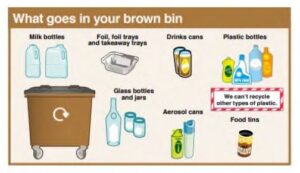
What goes in which wheelie bin?

The “Lets Recycle Right” image illustrates examples of items that can be recycled and which bin you should use to dispose of them.
All waste that is unable to be recycled must be put into the grey/black household waste bin, as this is for general waste.
Click the button below to be directed to Manchester City Council’s website, to see which recycling bin to use depending on your waste.
Which Bin Should I Use?Each bin/container provided is for specific waste, you must ensure that you do not cross contaminate when disposing of rubbish. For example: if the blue bin is for paper/cardboard, do not put general waste in here and vice versa. If you cross contaminate waste, the council will refuse to empty your bin(s) and fine you for this.
Bin collection days
Click the button below and simply enter your postcode to find out which day your bins will be collected. Make sure you remember to put your bins out the night before, as bins are usually collected early in the morning (7am onward).
What Is My Bin Collection Day?
Report a missed collection
If your bin is not emptied on the bin collection date, check that you are putting the correct bin out on the right day, and that they aren’t cross contaminated. Cross contaminated bins will not be collected.
If this is not the issue, report the missed collection to MCC via the button below.
Report A Missed Collection
Replacing a missing wheelie bin
If your bin has gone missing or been stolen, you will need to order a replacement via the MCC website.
Replacement general waste bins are around £20-£25 each. MCC only allow one general waste bin per property, you cannot apply for additional general waste bins.
Recycling bins are free to order, you can have as many as you wish.
Drake & Co/your landlord are not responsible to replace your bin if it goes missing or is stolen during your tenancy. Make sure that you collect your bin as soon as you can after it has been emptied, it is less likely to go missing!
Order A New Wheelie Bin
Apply for a larger grey wheelie bin
MCC only allow one general waste bin per property, you cannot apply for additional general waste bins.
Standard wheelie bins are 140 litres. If you are part of a large household (e.g. renting with six or more people) you may be entitled to a larger grey bin (240 litres). You will need to contact MCC to request the additional waste capacity. Click the button below to submit an application form to MCC if you believe you are entitled to a larger bin.
Apply For A Larger Grey BinCommunal Containers
Communal bins are shared between the streets they are placed on and are usually located at the end of the road/in an alleyway. Sometimes, communal bins are locked behind a gate installed by Manchester City Council. This is to prevent members of the public from fly-tipping as these bins are for residents only.
Communal Bins are substantially larger than wheelie bins, as they are for the surrounding premises, not solely for each household.
What goes in which communal bin?


The bins are usually labelled to say which type of waste should be put in which bin.
1) Black/grey container- domestic/household rubbish (waste that is unable to be recycled)
2) Blue container- paper and cardboard
3) Brown container- glass and plastic bottles
Each bin/container provided is for specific waste, you must ensure that you do not cross contaminate when disposing of rubbish. For example: if the blue bin is for paper/cardboard, do not put general waste in here and vice versa. If you cross contaminate waste, the council will refuse to empty the bin(s) and fine you for this.
Bin collection days
Click the button below and simply enter your postcode to find out which day your bins will be collected. Make sure you remember to put your bins out the night before, as bins are usually collected early in the morning (7am onward).
What Is My Bin Collection Day?
Accountability with communal bins
It is much more difficult to establish accountability if a communal bin has been overfilled, as they are shared between multiple households. We would recommend monitoring the communal bins throughout the week to ensure that rubbish is being disposed of appropriately. If you find excess rubbish has been placed around the bin(s), report this to the council immediately, to prevent this from attracting rodents to the area.
Excess Waste
Overflowing bins
Do not let excess waste pile up in your garden, on the street or around your wheelie/communal bins. Not only is this unsightly, this also attracts vermin and you could be fined by Manchester City Council (up to £1,000 plus the cost of removing the rubbish).
It is essential that when you are recycling/emptying your waste into the bins provided, they are not overfilled and you do not leave waste exposed. You must ensure that the lid of the bin can close completely, otherwise there can be a number of consequences, such as: your bin is not emptied, waste is scattered by the elements, pests are able to scavenge exposed rubbish etc.
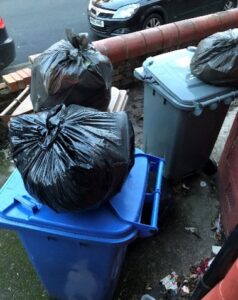
If your refuse isn’t collected, this will begin to pile up around your bin which is unacceptable. Rubbish must be kept secured within the bins provided, tenants will be responsible for the cost of removing any exposed waste.
The images below have been taken at some of our properties throughout the tenancy, leaving your bins in this condition is unacceptable.

Fly-tipping
Fly-tipping is defined as: “the illegal deposit of any waste onto land that does not have a licence to accept it”.
If you leave excess rubbish outside of your property/in an alleyway, this is classed as fly-tipping which you can be fined and/or prosecuted for.
CLICK HERE to report any instances of this to Manchester City Council who will be able to advise you further.

Where to dispose of excess waste
Click Here to see tips, dumps and recycling centres available in Manchester.
Manchester City Council may also provide you with pink (special collection) bin bags which you can use for any excess waste. You will need to apply for these via your account with Manchester City Council.
If you are unable to get to your local tip/recycling centre, do not worry. There are many mobile rubbish removal companies that collect rubbish from the property directly, you can find these by searching online or social media sites. Alternatively, contact Drake & Co as we can recommend reliable contractors that may be able to assist and provide a quote for this work.
Large Unwanted Items
Manchester City Council can collect large unwanted items (such as furniture). They offer one free collection of up-to-three large items per property per year, so use this responsibly. After that, you need to pay for the collections. Click Here for more information or to arrange a collection.
Donating unwanted items
If you are moving out or have unwanted items that are still in good condition, donate these!
Donate your clothes, books, electricals and large items to charity to help those in need.

GIVE IT DON’T BIN IT is a student move-out collection and recycling campaign.
There are various pop-up locations throughout the local area: Landcross Road, Monica Grove, Whitby Road, Lombard Grove, Booth Avenue, Withington Library, Hathersage Road, Brailsford Road.
Click Here for more information.
Utilities and Energy Saving
We encourage all tenants to be energy conscious and consider the effects wasting energy has on the environment and your utility bills.
For tenants that have taken an Inclusive Bills Package, please remember that as part of your contract, you have agreed to:
-
Send regular meter readings
- Adhere to the Fair and Acceptable Usage Policy
-
Keep your energy usage within reasonable limits
Tenants are responsible for their energy consumption, for monitoring their usage and making the necessary adjustments to ensure that this is not excessive. Throughout the duration of your contract, you will need to consider the following:
Energy Saving Tips
Only you can make sure you are using your energy effectively. These tips are being provided as guidance, we cannot force anybody to follow them, although we do advise you to.
DO’S
• Turn lights off when leaving a room
• Use energy efficient bulbs
• Wash clothes at cooler temperatures
• Keep windows and doors closed to retain heat
• Use your boiler timer and thermostat responsibly
• Wrap up warm with a blanket, or wear an extra layer of clothes
• Utilise the libraries and resources that your university offers
• Communicate with others to identify the most effective times for the heating to be on
• Cook together where possible to reduce the amount of times appliances are used
DON’TS
• DO NOT use electric heaters!!
• DO NOT leave electronics and appliances plugged in unless they are in use
• DO NOT run appliances (dryers/dishwashers) when they are not full
• DO NOT leave the heating on constant
• DO NOT set the heating to come on whilst nobody is home
• DO NOT take long showers. Experts say anything more than 5-10 minutes is too much.
• DO NOT leave LED lights or strips on/plugged in
• DO NOT use fans unnecessarily
• DO NOT turn the heating on if there are only one or two people home
• DO NOT leave phones/laptops plugged in if they are fully charged
Gas
– Speak to your housemates. This may seem obvious, but speaking to your housemates is an easy task which can make a huge difference. Establish when people will be in the property, work out the most effective times for the heating to be on and turn it off once the property is sufficiently heated.
– Use your boiler timer. Never leave your boiler set to constant! This will constantly use energy and you could damage the heating system. Use the programmes on your boiler and set this to timer (or off). Refer to the Appliances, Maintenance and Living in your Property Guide for step-by-step instructions.
– Dress for the temperature or wrap up in a blanket! Extremely simple, very effective and no added costs. It can be tempting to just crank up the heating when it gets cold, but take a second to work out if you’d be more comfortable with an extra layer or two on, or whether wrapping up in a blanket would do the job.
– Give the boiler a break. Turn the boiler off if nobody is around. But, during the colder months, don’t forget to set the heating to a very low temperature for at least 1-2 hours twice a day (especially during the Christmas break), which will ensure that pipes don’t freeze and/or burst. Please do not turn the boiler on and off on a daily basis as this can damage your boiler, instead use your timers.
– Don’t have the heating on whilst your radiator valves are off. Turning your radiator valves off does not turn your heating off, it only turns that radiator off. Your heating system will still be on and consuming energy unless you actually turn the heating off using the boiler programmes. Having the heating on whilst the radiators are turned off is a huge waste of energy, as your boiler will still be pumping out, but none of the rooms will be heated.
– Spend a reasonable amount of time in the shower. The recommended shower time is between 5-10 minutes, experts say anything more is too much. Whilst longer showers may be tempting, spending even a minute less in the shower every day can make a real difference to your annual consumption.
– Check your ventilation. Keeping doors and windows closed whilst the heating is on is a great (and free) way to keep heat from escaping. However, please note that improper heating and ventilation can encourage condensation, which produces mould. Therefore, you will need to open windows for a short period of time every day (when the heating is off) to help reduce the risk of condensation issues.
Electricity
– DO NOT use electric/portable heaters. These are prohibited, as per your Tenancy Agreement. Not only can these be dangerous fire risks, they also use lots of electricity.
– Cook and clean together. Reduce the amount of energy required for cooking, washing clothes, dishwashing etc by sharing loads with your housemates. Where possible, try putting food in the oven at the same time and only run appliances when full. This means the appliances will need to be used fewer times each day which can massively reduce your energy bills!
– Turn off computers when you’ve finished. If the computer has to remain on, then turn off the monitor to save energy.
– Remember to unplug all of your devices when they’re fully charged or not in use. Between 9-16% of electricity consumed in residences is used by appliances when they are in standby mode. Make it a habit to unplug chargers, laptops, and other electronics when you’re not using them.
– Turn off lights when leaving a room. Be extra energy conscious and use energy saving bulbs. Traditional lightbulbs turn electricity into approximately 95% heat and 5% light. Low energy lightbulbs use 90% less energy.
– Utilise natural light. Make the most of natural light during the day to minimise the need for artificial lighting. Keep curtains and blinds open to let sunlight in.
– Wash clothes on a lower temperature where possible. Most of your washing can be done at a lower temperature (like 30 degrees) and still provide the same results. Doing this will help to reduce your electricity consumption as your washing machine won’t need to heat the water to such a high temperature.
– Dry clothes outside instead of using the dryer. Using a maiden or washing line in the yard to dry clothes is free, make the most of this where you can to avoid having to use the dryer.
– Spend a reasonable amount of time in the shower. The recommended shower time is between 5-10 minutes, experts say anything more is too much. Whilst longer showers may be tempting, spending even a minute less in the shower every day can make a real difference to your annual consumption.
– Make sure your immersion water heater is off (if you have one). These are very expensive to have on constantly and are a huge waste of energy. Immersions heat the water tank using electricity instead of gas. These should only be used in the event of an emergency (e.g. if your boiler has stopped working and cannot heat your water).
– Use energy-efficient appliances like microwaves and air fryers instead of the oven whenever possible. Share the oven when cooking – utilise its full capacity when you do use it.
Educate housemates! Share these energy-saving tips with your housemates. Encourage everyone to be mindful of energy usage and work together to implement these practices.
Submitting Meter Readings
Tenants must submit regular meter readings to ensure that your bills are accurate and you are not being over/undercharged for your energy usage.
Even if you have smart meters installed, you may still need to send manual readings to ensure there are no problems, as some smart meters may not have a great connection and can struggle to pull the reads across to the energy company.
If you have arranged your own utilities, submit these to your utility supplier following their instructions.
If you have taken the bills package with Bills Paid Ltd, you must send any/all meter readings directly to Bills Paid Ltd via email (info@billspaidltd.co.uk). You do not need to send meter readings to Drake & Co unless we request them from you.
If you are unsure about your type of meter and/or how to take a meter reading, please CLICK HERE for detailed step-by-step instructions and refer to the Appliances, Maintenance and Living in your Property Guide.
Inclusive Bills Agreement
Almost all of our properties have utilities managed by Bills Paid Ltd. CLICK HERE to see an example copy of the Bills Paid Ltd Inclusive Bills Agreement. Your actual contract will have been sent to you via email using DocuSign, and in an email along with your Tenancy Agreement.
This is a contract between Tenants (you) and Bills Paid Ltd (the bills management company). Drake & Co act as Agent on behalf of Bills Paid, meaning we advertise their package and collect payment on their behalf. Drake & Co do not have access to your utility accounts.
If you have taken a property where the landlord includes the utilities within the rent, this would’ve been confirmed when securing the property and the utilities would’ve been written into your Tenancy Agreement. The terms of your inclusive bills will differ slightly to those set out by a bills management company, therefore you will need to refer to your Tenancy Agreement for information and instructions that you will need to follow.
Communicating with Bills Paid Ltd
If you have any questions or concerns about your usage or utility accounts, please contact Bills Paid Ltd directly using: info@billspaidltd.co.uk.
Bills Paid will communicate with you and send newsletters via email, please respond to their communications directly with any queries you may have.
Drake & Co act as Agent on behalf of Bills Paid, meaning we advertise their package and collect payment on their behalf. Drake & Co do not have access to your utility accounts.
Fair Usage Allowance
Bills Paid Ltd’s Bills Agreements include a Fair and Acceptable Usage Policy. It is imperative that tenants are aware of this and understand your responsibilities relating to this.
You have agreed to a Fair Usage Allowance and if you exceed this amount, you will be responsible for any charges outside of the allowance.
Bills Paid have designed the allowance to be a generous figure, so it is unlikely that you will exceed this as long as you are sensible with your usage. The figure is usually calculated taking into consideration a variety of factors, such as rates at the time of securing the contract and the average usage at similar sized properties over the years.
You may receive emailed updates from Bills Paid throughout the course of your contract with them, to let you know about your usage or if they notice any unusually high bills. However, please do not rely on them to notify you of high bills. It is your responsibility to monitor your usage, to be sensible with your consumption and to make the necessary adjustments to your consumption habits to avoid exceeding your allowance.
If you have any questions or concerns about your Fair Usage Allowance, or you would like any updates regarding this, please refer to your agreement and/or contact Bills Paid using: info@billspaidltd.co.uk.
Fire Safety
In the event of a fire
If there is a fire, immediately evacuate the area, alert everyone around you by shouting “fire,” and call the fire department (999) once you are safely outside; do not attempt to fight the fire or go back into a burning building to retrieve belongings.
• Raise the alarm: Shout “fire” loudly to alert everyone in the building.
• Get out quickly: Follow the safest escape route and exit the building as fast as possible.
• Close doors behind you: Shut doors to contain the fire and slow its spread.
• Stay low to the ground: Crawl if there is smoke to breathe cleaner air.
• Feel doors with the back of your hand: Check if a door is hot before opening it.
• Do not use elevators: Always use the stairs to evacuate.
• Call emergency services: Once outside, call 999 to report the fire immediately. Notify Drake & Co and/or the out of hours contact as soon as possible (0161 224 2134).
• Do not go back in: Never re-enter a burning building to retrieve belongings.
A headcount should be completed once safely outside and the fire department must be notified of anybody remaining inside the property.
Tenants are responsible for sharing the fire safety information with any visitors they allow into the property. Tenants should be aware of the number of people (housemates and visitors etc) within the property at all times.
Our Appliances, Maintenance and Living in your Property Guide includes further fire safety tips/advice. It also contains information about fire safety equipment you may find in the property and your responsibilities for maintaining these.
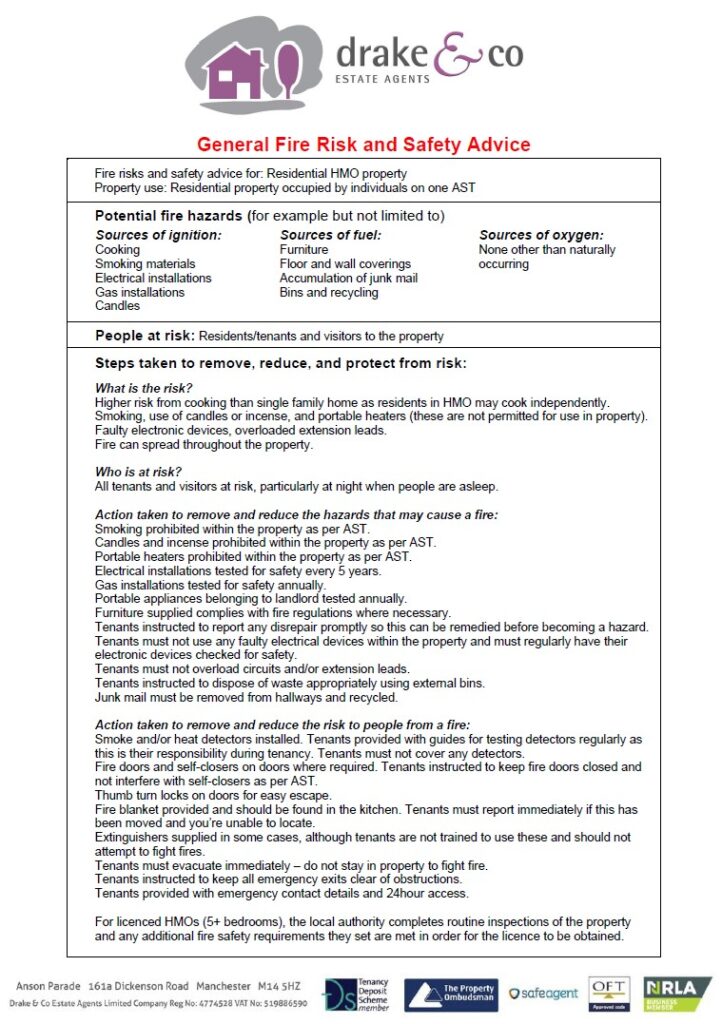
Check out the Moving in Guide below, this will assist you through all aspects of the moving in process, including key collection procedures, moving essentials, setting up your utilities, registering for council tax, etc.
Check out the Moving out Guide below, this will assist you through all aspects of the moving out process, including cleaning requirements, key return procedures and the process of getting your deposit back.